Monday, February 28, 2011

It Takes A Thief - Discharge Papers


 A while back, I wrote about breaking into the locked “safe” in my parents’ basement. Inside were numerous papers belonging to my grandparents. One of those items, I was particularly excited to discover was my grandfather's World War I discharge papers. Initially I thought they were the originals but upon closer examination I noticed they are a notarized copy. If you're familiar with the 1973 fire at the National Personnel Records Center, you know that this is quite an exciting find.

The Enlistment Record portion expands on some of the details of my grandfather's service. This should help me verify information that I've pieced together from other sources and provide a more complete timeline. Down at the bottom in the notary area, it states that my grandfather has the original in his possession. I'm still hoping the original will turn up and have no doubt it might.


I also noticed Grandpa recorded his discharge papers with the Spokane County Auditor upon his return from the war.


I can see why Grandpa kept his discharge papers locked up and am thankful that he did.

© 2011, copyright Michelle Goodrum
Photo by Marcin Wichary

Saturday, February 26, 2011

Rescue From The "Chemical Sandwich of Doom" on Sorting Saturday

During a recent sorting episode, an album turned up in the Family Home. Husband and I were the star subjects as it was an album of snapshots from our wedding day, taken by the unofficial photographer (aka Dad)! I gasped in horror when I opened the album and saw what was inside. The pictures were neatly arranged in one of those horrible sticky "magnetic" albums that we now know are dangerous for our beloved photographs. Hence the name, Chemical Sandwich of Doom, given by one of my favorite archivists, Sally Jacobs, The Practical Archivist. (You can read even more about the Chemical Sandwich of Doom here.)

I decided to try out my new Flip Pal on this album. So one evening while watching TV, I carefully removed the pictures one by one, scanned them using the Flip Pal, and placed them in a new archival safe album. When the scanning was done, it was easy to load the pictures onto my laptop, in one batch, using the following filename format:

LastName_GroomBride_YYY-MM-DD_wedding

As a side note, I also found a "Mother's Album" containing pictures from the same day whose materials were much friendlier to photos than the Chemical Sandwich of Doom. You could definitely see the difference in the condition of the pictures between the two albums.

Another rescue mission accomplished.


© 2011, copyright Michelle Goodrum

Wednesday, February 23, 2011

Monday, February 21, 2011

Calculators - 52 Weeks of Personal Genealogy & History -Week 8


With the rapid technological advances in personal computing and the popularity of the World Wide Web over the last couple of decades, it’s hard to believe a handheld calculator was ever considered revolutionary. This baby was a huge deal in our family. Not only would it perform the basic functions of addition, subtraction, multiplication and division, it had a memory, would calculate square root, sine, cosine, tangent and all kinds of other functions that a high school student would need (and that I can no longer remember)!


Consider this: in just a few short years we went from the stone age tools of the slide rule


And the adding machine that had been around for decades,


to a hand held calculator that would add, subtract, multiply, divide, and store the results


To the TI 30. And so on...

It really is similar to the rapid increases in power we have seen in personal computers in the last several years. Actually it is the early stages.

I am just happy that I never had to learn how to use a slide rule!

52 Weeks of Personal Genealogy & History by Amy Coffin, of The We Tree Genealogy Blog, is a series of weekly blogging prompts in 2011to encourage you to record memories and insights about your life.

Slide rule photo by Tsuyoshi Adachi as thin-p

All other photos by Michelle Goodrum

© 2011, copyright Michelle Goodrum

Friday, February 18, 2011

Baby Catch A Ball – 52 Weeks of Personal Genealogy & History -Week 7


I have to say I’m not really sure what my favorite toy was but I do have fond memories of Baby Catch A Ball. She was a Christmas gift, from Santa, discovered early Christmas morning by Sibling who snuck out to discover the treasures Santa left under the tree. I was then awakened and quietly ushered down the hall to be shown my new toy.

Baby Catch A Ball was a revolutionary, battery operated doll who would catch the ball when tossed to her just so. Then she would toss it back. At the time, she was lots of fun.

52 Weeks of Personal Genealogy & History by Amy Coffin, of The We Tree Blog, is a series of weekly blogging prompts in 2011to encourage you to record memories and insights about your life.

Related Posts:

© 2011, copyright Michelle Goodrum

Friday, February 11, 2011

Here Come the Brides - 52 Weeks of Personal Genealogy & History-Week 6

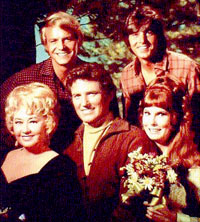
I had so many “favorite” televisions shows growing up that it’s hard to choose just one. However, there is one TV series I have close personal ties to that also stands out as a favorite. Here Come the Brides aired in the late 1960s and early 1970s and was set in Seattle near where I grew up, making it a hit series with the locals. Teen heartthrob, Bobby Sherman starred.

The premise of the series was that the young logging town of Seattle had a shortage of marriageable young women so volunteers from New England were brought west looking for husbands.

My connection, besides growing up in the Pacific Northwest, was that one of the brides, and a main character, Candy, played by Bridget Hanley, grew up a couple of blocks from where my family lived. In fact, her family home was right next door to my elementary school. Bridget’s grandmother lived in a little house in the woods in the back of their property. The school playground adjoined those woods and occasionally we would go over to the fence when Bridget’s grandmother was out around her house and visit with her.

One summer Bridget came home for a visit and an autograph session was arranged on her front porch. All the neighborhood kids and other fans waited in line to meet Bridget and get her autograph. Unfortunately, my family was out of town on that day and my parents wouldn’t bring me home so I could get Bridget’s autograph! We really weren’t very far away and I just couldn’t understand why they wouldn’t bring me home. So I had to be satisfied with verbal descriptions of Bridget, her hairdo, and her attire from my friends.

52 Weeks of Personal Genealogy & History by Amy Coffin is a series of weekly blogging prompts in 2011to encourage you to record memories and insights about your life.


© 2011, copyright Michelle Goodrum

Thursday, February 10, 2011

It Takes A Thief - To Solve a Birth Record Mystery - Part 4

Photo by Marcin Wichary
If you are coming into this series on my grandparents' efforts to provide proof of their age for Social Security and my efforts to locate an original birth record, you might like to catch up by reading Part 1, Part 2, and Part 3.

What I found interesting in this document called Instructions on Required Proofs that Grandpa received from the Social Security Administration, is that there were two categories under Proof of Age.

Social Security preferred documents from the first category- Documents Usually Recorded in Early Life. Notice the last item - f - U.S. census record for the first or second census after birth. That is what Richard obtained back in 1960 (see Post 2).  I was surprised that the first or second census record after someone's birth would fall into this category.


Here was another surprise. In the second section, is a list of documents that could be used if a document recorded early in life was not readily available. Note item s - Delayed birth certificate.


Maybe I am mistaken but it seems like I've read, in several places, that people born before vital records were required to be kept often would obtain a delayed birth certificate in order to collect Social Security benefits. Yet here on this form from 1965 (see the year on the bottom of the form), the Social Security Administration is saying that a census record for the first or second census after birth is preferable to a delayed birth certificate. Very interesting.

Richard did end up sending in his Census Bureau transcript as proof of birth asking that it be returned to him, which it was (see Exhibit 5 below).

Summary
Sometimes in our research we need to accept that not finding something is still a good thing. I am thinking there is no reason to continue looking for a birth certificate for Grandpa, or a delayed birth certificate. He used a 1900 Census Bureau transcript as proof of his birth with the Social Security Administration probably because a birth certificate doesn't exist.

Going back to the original hypothesis in Part 1: Richard Roos was born 7 August 1895 in Los Angeles, California. It looks like I may have to be satisfied with the other sources I already have that prove this. That's OK as I have plenty of convincing evidence that my hypothesis is true (not to mention the fact that I used to send Granpa a birthday card every August!). If I could just get the Archdiocese of Los Angeles to cough up the baptismal record...

I hope you enjoyed this series and that it helps you with solving a genealogical problem of your own.

Exhibit 5 - Letter from Richard Roos to Social Security, dated 4 November 1965,submitting proof of birth


© 2011, copyright Michelle Goodrum