Saturday, March 12, 2011

When is it OK to Throw an Old Photo Away? - Sorting Saturday

Several days ago Nolichucky Roots called my attention to a fantastic article over at a blog that is new to me called ArchivesInfo. The title of the article is Culling Family Photographs and it has some wonderful tips on that subject.

One sentence really caught my attention because it's something I really struggle with.

If an old image sits around for years and nobody can be found who knows anything about it, do you really need to keep it? (No)

An accurate statement, in my opinion. But how many years does it take before you decide to toss an old photo? How hard to you look for that somebody, somewhere who knows about that old picture? How hard and long do you look for that piece of information, that tiny clue to open the story of the photo? The answer is going to vary from person to person. So what are some of the factors that play into answering this question? Here are a few that I came up with.

  1. How important is the picture to you? How important do you think it might be?
  2. What other items or photos are with the picture that you found that could potentially provide clues?
  3. Is there anyone living in your family who might know something or someone that could give you the answers you seek or at least some leads?
  4. How many items like this do you have?
  5. How much room do you have to store these types of items?
  6. How much time and effort do you want (or are able) to put into your search?
  7. How broadly do you want to search? Immediate family? Extended family? Message boards? Historical Societies?
  8. Is there anyother family member who would like to have the photos?
How have you handled the issue of orphan photos? What do you consider to be important considerations in decided what to keep and how long to keep it?

© 2011, copyright Michelle Goodrum

Friday, March 11, 2011

Using Land Records To Solve Genealogical Problems - Part 2

In Part 1, I explained how I located and ordered a land record file for my ancestor William H. Ballenger in Mahaska County, Iowa. In the next several posts, we will go through the file page by page.

As a side note, NARA now gives the option of ordering files like this in paper form or on a CD. I opted for the CD version since I'm trying to keep get the piles of paper under control. I was pleased with how quickly I received it.

The first document explains the law under which William obtained his property. In a nutshell, William Ballenger got his Iowa land under the February 11, 1847: ScripWarrant Act of 1847 (9 Stat. 123). The portion of this act that applies here basically states those who served in the Mexican American War received a warrant or certificate for 160 acres.

You can read the entire document if you are so inclined. Click on the image to view a larger version and then click on the back arrow button to return to this post. If the larger version isn't big enough try this tip I learned from Dick Eastman's article, "Are You Still Printing Everything?" For Windows users: hold down the Control key (Mac users hold down the Command key) and press the plus key to make it even bigger (minus key makes it smaller).

In Part 3 we'll get into the meat and potatoes of William's file.


For a full list of posts in this series, go to Using Land Records to Solve Genealogical Problems Compendium.
© 2011, copyright Michelle Goodrum

Thursday, March 10, 2011

Congratulations to Family Tree Magazine’s 40 Best Genealogy Blogs 2011

The list of Family Tree Magazine's 40 Best Genealogy Blogs for 2011 is out online! Congratulations to all of the wonderful blogs who made the list this year.


© 2011, copyright Michelle Goodrum

Tuesday, March 8, 2011

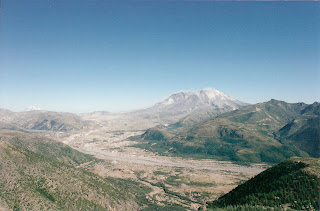
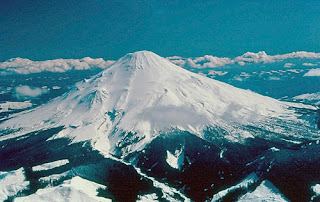
Mt. St. Helens Eruption - Disasters

   
West side of Mount St. Helens, looking up the South Fork
 Toutle River valley March 25, 1980. By WAstateDNR

© 2011, copyright Michelle Goodrum The Eruption of Mount St. Helens is the only natural disaster that I have truly lived through. There isn't a May 18th that has gone by since 1980 that I don't think about that day. At the time, I was a student at Washington State University, in Pullman which is in eastern Washington, and experienced the ash fallout with its resulting aftermath first hand. The morning of the eruption, a Sunday, I woke up to what I can only describe as weird, greenish lighting outside. Slowly day turned into night as the ash coming our way covered the sun and began to fall from the sky. By mid afternoon it was as dark as midnight and we were being cautioned against going outside as there might be poisonous gasses in the ash.

May 18, 1980 eruption. Photo by WAstateDNR.

Students who lived in the surrounding dorms had to go outside to get to our dining hall in order to eat. I was fortunate in that my dorm was attached to the dining hall. Sudents coming into our dining hall from other dorms had to wear layers of clothing to protect against the ash. Some students dressed up like Star Wars storm troopers and even Darth Vader, complete with light sabers!

Surface of the debris flow in North Fork Toutle River valley,
looking southeast toward the volcano. May 24, 1980.
Photo by WAstateDNR.
The university was closed for several days; something that even snow couldn't do. People couldn't drive their cars without the engine being choked on ash. The state patrols had to put these huge filters on the front of their patrol cars to keep the ash out of the engine.

Unfortunately, that was one of the only times in my life that I had no film for my camera and no way to get any as the student store, the only store within walking distance, was closed. However, I did scoop up some ash in a plastic cup. I still have that container of ash after all these years.
 
In 1997, our family had the opportunity to visit Mt. St. Helens and the visitor center at Johnston Ridge where David Johnston was camped that fateful morning and radioed in the eruption to the USGS base in Vancouver. Seventeen years after the eruption life was returning to the once sterilized area but evidence of the eruption's power was still evident everywhere.
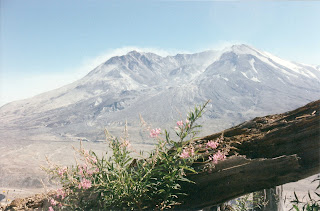
Mt. St. Helens from Johnston Ridge.
August 1997. Photo by Michelle Goodrum

From the Northwest, August 1997. Photo by Michelle Goodrum.
   52 Weeks of Personal Genealogy & History by Amy Coffin is a series of weekly blogging prompts to encourage people to record memories and insights about their lives for future descendants. It's not necessary to be a blogger to join in. Just record your memories on your own if you wish.

Monday, March 7, 2011

Using Land Records to Solve Genealogical Problems - Part 1

A while back my search into the earlier years of William H. Ballinger's life, in the hope of eventually identifying his parents, led me to the Bureau of Land Management's General Land Office Records website. I love land records as they can be chock full of valuable and interesting information. What I discovered this time did not disappoint (although I'm still working on his parents). I thought I would share this particular land file with you as it is different from others I have used, and, well, we'll just see where this goes.

On this particular trip to the BLM website, I searched several spelling variations of Ballenger in Mahaska County, Iowa since that is where I have found William and family in several Iowa State censuses in the 1850s. Here are the results:


Using the information listed for William H. Ballenger, I was able to order this particular land file from the National Archives and Records Administration.

Next up, I'll present the contents of William's land file, lessons learned, and what questions came up. This particular file is different from others I have ordered in the past so it raises a whole new set of questions.

Later on, we will revisit this results list and see how some of these other Ballenger/Ballinger individuals might fit into the picture. One thing at a time...

For a full list of posts in this series, go to Using Land Records to Solve Genealogical Problems Compendium.

© 2011, copyright Michelle Goodrum

Friday, March 4, 2011

I'll get you my pretty, and your little dog too - Sounds


Photo by Michelle, ceramic witch by Mom

Week 9: Sounds. Describe any sounds that take you back to your childhood. These could be familiar songs, jingles, children playing, or something entirely different.

When I saw the prompt for this week, the Wicked Witch of the West from the Wizard of Oz immediately popped into my head! I'm not sure why because I'm completely over her and there are so many other interesting sounds that come to mind. But there she was so I'm going to work with it.

Like many other children, I was terrified by the Wicked Witch of the West and probably even more scared of the music that accompanied her. We would watch The Wizard of Oz every year on TV. Every year when either the music or Elba (as we now know her to be called) would enter, I would exit down the hall to my room where I would usually stick my head under a pillow until I was sure it was safe to come out. I was terrorized by her the rest of the year as well. My parents had the sound track album and Mom would occassionally play it. Off I would go in search of a pillow until that awful music was over!

I can even remember Dad making me sit through the scene when Dorothy threw the bucket of water on the witch and made her melt away. I still didn't want anything to do with that witch.

"Going so soon? I wouldn't hear of it. Why my little party's just beginning. ..." Listen here for a quick blast from the past my pretty.


52 Weeks of Personal Genealogy & History by Amy Coffin, of The We Tree Genealogy Blog, is a series of weekly blogging prompts in 2011to encourage you to record memories and insights about your life.


© 2011, copyright Michelle Goodrum